Wednesday, 30 September 2015
Using Magazines
During studio time, I took advantage of the fact I was not in an open space and began collecting magazines. From these magazines, I have carefully cut out people that I can show in situations that look most interesting. For example, someone sitting down could be placed on a kerb or bottle lid. Showing the difference in size exaggerates how small the cut-outs are. I cut out a picture of a woman sunbathing, and ironically placed her on a bin in the studio. Through her facial expression, she is having a good time, whereas placing her on a bin shows that she is in a situation where she would not be. I took a picture of this close up, and then far away, showing other objects around the studio. Doing this makes her look almost unnoticed, but the close up shows that in her world, she is happy. I believe this to portray how irrelevant other people's emotions are to eachother and how we literally ignore them. It shows that no one else really cares about other people's happiness or problems, and that everyone's world, to them, is their own.


Experimenting With Proportion
OTo develop my images further, I decided to introduce people into them. I did this by asking the person to stand far from the camera, and use the same floor level technique. For example, I would line up the person at the same level as the grass, making them look the same size or even smaller than the blades of grass (that were closest to the camera).


Collected photographs
During the summer, I spent most of my time visiting various places such as Coombe Abbey, Kingsbury Water Park and Bosworth Water park. I also spent most of my time in a small village which is surrounded by fields and forests. I took advantage of this as the scenery around me could be exaggerated in a photograph to look larger than life, or for the person who is viewing the image feel smaller than life. I began taking pictures of the area around me and began manipulating the proportion of what's seen in the image to show a contrast of size.  If I lay the camera on the floor, objects such as grass look larger than they do from eye level.
  Taking pictures from floor level makes an illusion of feeling smaller than life. It also exaggerates the insignificance of man-kind using scale.


 If I lay the camera on the floor, objects such as grass look larger than they do from eye level. Taking pictures from floor level makes an illusion of feeling smaller than life. It also exaggerates the insignificance of man-kind using scale.
 Friday, 11 September 2015
Discovery of A New Artist - Slinkachu
Slinkachu, born in 1979, is a British street artist, photographer and blogger. He has become known especially for his Little People, which he installed at various locations in London since of 2006. His art was presented in a series of exhibitions in London and Norway. Slinkachu presented his art since 2006, mainly through the installation of scenes with painted train model figures (Little People) which he placed in the road space in London in different scenes. It may be everyday scenes or depictions of accidents, including for example a figure floored under a stubbed cigarette butt (Stubbed Out, 2007) or a worker who is a Gulli braces (Drain Guy, 2007). He is also working on installations with several figures and other objects, as in They're not Pets, Susan, 2007 in which he shows a man with hunting rifle and a young girl at a dead bumblebee. The magazine Art wrote his figures stood "for the isolation and loneliness in big cities". [3]
Another project is the Inner City Snail Project, in which snails with miniature graffiti or other adornments provided to be placed in the city.
His fondness for miniatures in Slinkachu according to the type with the following words: "I like to think that almost no one sees my work. Because we all inadvertently or purposefully ignore much of what surrounds us in a city. "[3]
Since 2007, there are similar installations under the name cork males also in Berlin.
Another project is the Inner City Snail Project, in which snails with miniature graffiti or other adornments provided to be placed in the city.
His fondness for miniatures in Slinkachu according to the type with the following words: "I like to think that almost no one sees my work. Because we all inadvertently or purposefully ignore much of what surrounds us in a city. "[3]
Since 2007, there are similar installations under the name cork males also in Berlin.
Cornelia Parker Research
English sculptor and installation artist. She undertook her BFA at Wolverhampton Polytechnic (1975–8) and her MFA at Reading University (1980–82). Her early installation works were imbued with poetic innuendos linked to the fragility of human experience. Cold Dark Matter: An Exploded View (1991, London, Tate) is the restored three-dimensional volume of a garden shed exploded by the British Army at the request of the artist. The surviving fragments, suspended from the ceiling and lit by a single bulb, create a dramatic effect and cast shadows on the gallery's walls. Parker worked not only with the altered scale and substance of things, but also with the meaning conveyed by found objects. The Maybe, an exhibition made in collaboration with the actress Tilda Swinton (b. 1960) in 1995 (London, Serpentine Gal.) focused on the impressions that one has when confronted with the belongings of famous people. Parker selected curiosities from various museums, including Turner's watercolour box, Queen Victoria's stockings and Sigmund Freud's blanket, in order to elicit free associations from the beholder. Swinton was herself on display, asleep in another glass case. Parker's aim was not merely to question the power of relics, but also to create a mental route that triggers unexpected associations. The unconscious thread was made more humorously explicit in The Pornographic Drawings (1996, London, Tate) in which drawings resembling Rorschach blots were created from pornographic videotapes dissolved in solvent, the resulting marks resembling genitalia. She was shortlisted for the 1997 Turner Prize. - http://www.tate.org.uk/art/artists/cornelia-parker-2358
For some years Cornelia Parker’s work has been concerned with formalising things beyond our control, containing the volatile and making it into something that is quiet and contemplative like the ‘eye of the storm’. She is fascinated with processes in the world that mimic cartoon ‘deaths’ – steamrollering, shooting full of holes, falling from cliffs and explosions. Through a combination of visual and verbal allusions her work triggers cultural metaphors and personal associations, which allow the viewer to witness the transformation of the most ordinary objects into something compelling and extraordinary. - http://www.frithstreetgallery.com/artists/bio/cornelia_parker
For some years Cornelia Parker’s work has been concerned with formalising things beyond our control, containing the volatile and making it into something that is quiet and contemplative like the ‘eye of the storm’. She is fascinated with processes in the world that mimic cartoon ‘deaths’ – steamrollering, shooting full of holes, falling from cliffs and explosions. Through a combination of visual and verbal allusions her work triggers cultural metaphors and personal associations, which allow the viewer to witness the transformation of the most ordinary objects into something compelling and extraordinary. - http://www.frithstreetgallery.com/artists/bio/cornelia_parker
Chiharu Shiota Research
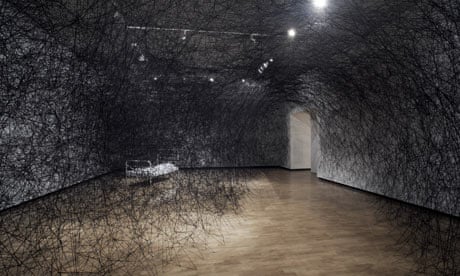
Chiharu Shiota is a spider-woman – one who clambers around in the skeins of our unconscious. In her best-known installations she weaves black yarn into hectic webs that take over entire galleries and in which personal objects are found cocooned. The Japanese Berlin-based artist has ensnared everything from the wedding dresses seen in last year's Walking in My Mind Exhibition at the Hayward gallery, to a grand piano and childhood toys. In one of her sleeping performances, you might even find Shiota herself ensconced beneath layers of mesh.
Born in Osaka, the artist moved from Japan to Germany in 1997, to study under the performance art maven Marina Abramovic. For one of her early works, Try and Go Home of 1998, Shiota fasted for four days and then smeared her naked body with earth before taking to a muddy hole. With its suggestions of both womb and grave, the work hinged on feelings of loss and oblivion that have underscored much of her work since. A later installation first shown in 2000, Memory of Skin, featured similarly dirt-stained dresses, suggesting knowledge that won't wash off.
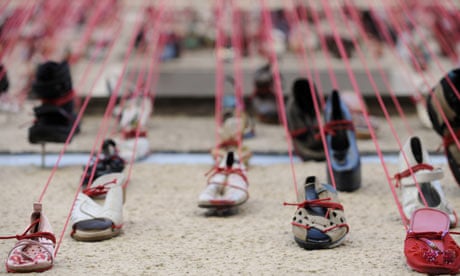
Personal experience is central to Shiota's work. For a project initially staged as Dialogue from DNA in 2004 in Poland and then recreated in Germany and Japan, she invited people to donate footwear with a memory attached – resulting in thousands of old shoes, many of which had belonged to loved ones who had died. She attached each to a taut red thread, a symbol of the path through life as well as the imprint of journeys taken.
There's a similar push and pull between closeness and separation in her sleeping performances, where women doze on neatly arranged hospital beds beneath a canopy of black threads. However intimate watching these people sleep might have felt, the artist implies that we can never know what's going on behind their closed eyes.
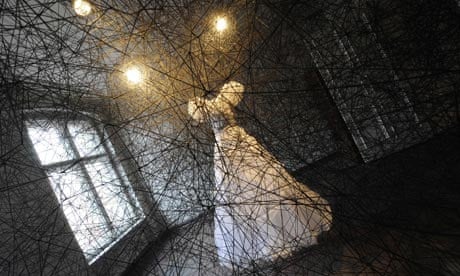
"It would be nice to banish every trace of myself, my looks, my papers, my passport, and even my fingerprints," Shiota has said, "and only create my works in dialogue with the cosmos." While exploring the hinterlands between waking life and dream states and chasing fading memories, in Shiota's labyrinthine installations the passage into oblivion always feels close at hand.
Sound of silence: When Shiota was nine years old her neighbour's house burned down; the following day the artist saw a charred piano amongst the ruins. This instrument that lost its sound has haunted the artist and inspired various works in which she sets alight to a grand piano, then displays the remains within an installation of black thread. - http://www.theguardian.com/artanddesign/2010/feb/24/artist-chiharu-shiota-installation
Wednesday, 9 September 2015
Isaac Cordal Research
Isaac Cordal is a sculpture artist from London. His sculptures take the form of little people sculpted from concrete in ’real’ situations.
Cordal manages to capture a lot of emotion in his vignettes, in spite of their lack of detail or colour. He is sympathetic toward his little people and we empathise with their situations, their leisure time, their waiting for buses and their more tragic moments such as accidental death, suicide or family funerals. His sculptures can be found in gutters, on top of buildings, on top of bus shelters – in many unusual and unlikely places in the capital.
Left to their own devices throughout London what really makes these pieces magical is their placement. They bring new meaning to little corners of the urban environment. They express something vulnerable but deeply engaging. Left to fend for themselves, you almost want to protect them in some way, or perhaps communicate with them. - http://pureevilgallery.virb.com/isaac-cordal-f7227#/id/i2467342
Cordal manages to capture a lot of emotion in his vignettes, in spite of their lack of detail or colour. He is sympathetic toward his little people and we empathise with their situations, their leisure time, their waiting for buses and their more tragic moments such as accidental death, suicide or family funerals. His sculptures can be found in gutters, on top of buildings, on top of bus shelters – in many unusual and unlikely places in the capital.
Left to their own devices throughout London what really makes these pieces magical is their placement. They bring new meaning to little corners of the urban environment. They express something vulnerable but deeply engaging. Left to fend for themselves, you almost want to protect them in some way, or perhaps communicate with them. - http://pureevilgallery.virb.com/isaac-cordal-f7227#/id/i2467342


- "Concrete Island" (Framed Version)

"Business Lunch" 2010

"Untitled"
Subscribe to:
Comments (Atom)